30 September 2026
ELU-S 2026 - "Words or Deeds? The European Moment"
By Remicard SEREME

This september, I took part in the second edition of the European Law Unbound Society (ELU-S) Conference on the theme "Word or Deeds? The European Moment" which took place in Lisbon, Portugal. I was happy to coordinate and participate in a roundtable and a panel focused on Black Feminist approaches to European Law.
Thinking EU law from the margins: applying black feminist thought to EU legal scholarship

Building on the conversation opened at last year’s ELU-S Conference on Black feminist epistemology, epistemic injustice and decolonising EU law, this panel aimed to move Black feminist thought from the margins of EU legal scholarship to its center by taking seriously its capacity to reframe how we understand, theorise and contest EU law. Bringing together work that spans dating platforms, corporate accountability, EU Equality law and European Family Law, the panel asks what becomes visible when Black lives and Black feminist insights are placed at the centre of EU legal analysis. Through these diverse contributions, the panel aimed to foreground alternative accounts of EU law and of the conditions under which people live, work and relate under the European Union’s legal order. Taken together, the different interventions illustrated that Black feminist thought is not an addendum to EU legal scholarship but a constitutive lens for re-reading its foundations, silences, and possibilities.
Black Feminist, Decolonial and Critical race approaches to European Legal Scholarship and Teaching
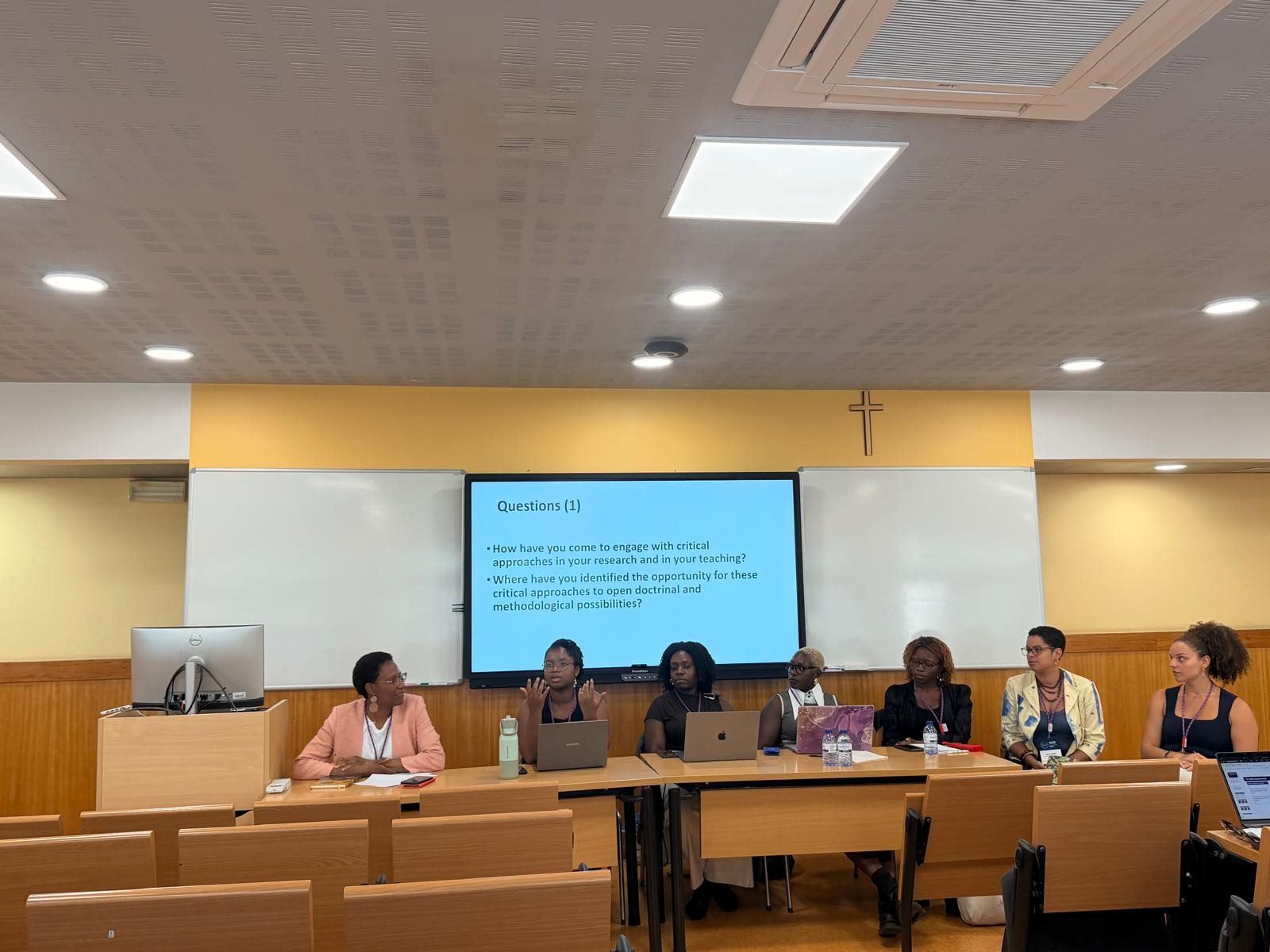
The European Union often speaks the language of equality, dignity, and the rule of law while deferring, diluting, or disavowing these commitments in practice. For example, while touting “Unity in Diversity”, the European Commission stands as a glaring illustration of lack of diversity in the highest sphere of the European Union (Solanke, 2025). This roundtable took the conference theme “Words or Deeds? The European Moment” as an invitation to ask how critical theory can participate in filling that gap. Drawing on Black feminist thought, decolonial theory, critical race feminism, and adjacent traditions, participants shared how they mobilise these frameworks in their scholarship, classrooms, and day-to-day navigation of academic institutions throughout Europe. The conversation brought together scholars at different career stages and from different European jurisdictions to compare how these theories can be mobilised to seize the “European moment”.
Central questions included: What does it mean to teach and research EU law, human rights, or public law through a Black feminist or decolonial lens in European legal academia? Where do these frameworks open doctrinal and methodological possibilities, and where do they meet institutional resistance? How do scholars sustain this work amid precarity, tokenisation, and marginalisation ?
Rather than producing a unified programme, the roundtable aimed to surface a plural, situated picture of critical theoretical practice in EU law and to strengthen the network of scholars doing this work across the continent.
Overall Lisbon treated us well and it was a wonderful occasion to be in community with fellow Black women researchers in Europe. I look forward to the next edition !