Book Talk - Colonialism and the EU Legal Order
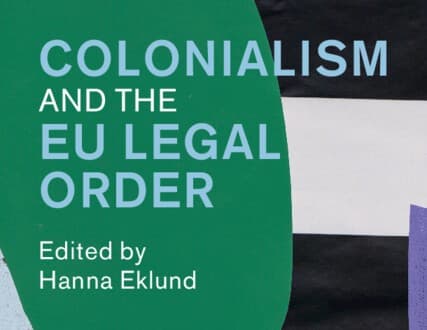
Earlier this month, I took part in the EUI Library's Book Talk Series on Colonialism and the EU Legal Order (Cambridge University Press, 2025), edited by Hanna Eklund, Assistant Professor at the University of Copenhagen and Fernand Braudel Fellow at the EUI Law Department. It was a pleasure taking part in this discussion, which was a full circle moment for me. When I was preparing to apply for the PhD, I stumbled upon the blog post published by this same professor on the Verfassungsblog on Colonialism and EU Law, which then led me to reading Professor Lionel Zevounou’s blog post For a Postcolonial Reading of the EU, opening the way for me to find Professor Iyiola Solanke’s work on Decolonising EU Law and Centering Black Women in EU Equality Law. Together, these works opened up a field of possibility in my head and made me realise that it was possible to research EU Law beyond the way that I had learned about it in Law School, i.e as a technical, apolitical body of rules mainly concerned with companies and competition in the internal market. 2 years later, I really appreciated the opportunity to participate in this conversation around this book in which both these professors contributed a chapter. One on Discrimination Based on Race - The Story of Moroccan SNCF Workers in France (Zevounou, 2025) and the other on Decolonizing Research and Teaching in EU Law - Purpose, Principles and Practice (Solanke, 2025).
Colonialism and the EU Legal order unsettles the grand narrative of the EU as a project of peace and unity aiming to move beyond nationalism in the aftermath of the Second World War (WII), reminding us that at the time of the signing of the Treaty of Rome in 1957, four out of six of the original member states were colonial empires. France, Belgium, Italy and the Netherlands were occupying territories spanning Africa, Asia, the Caribbean and the Pacific. The book offers a timely and critical examination of how this colonial history is still shaping EU law in the present.
Through this conversation, Ass. Prof. Eklund, my fellow discussant Luca Tenreira, and I reflected on the multiple forms of colonial continuities embedded in EU Law, from social Europe (migration, labour, etc), to infrastructural Europe (supply chains, agriculture, etc) to institutional Europe (values, reach, legitimacy…) and beyond. The discussion focused particularly on the state of research on this topic in the EU today and the different avenues that this scholarship can take in the future.
I think that this book supports a much needed reckoning with the legacies of colonialism in the EU and its influence on how people are able to live their lives under EU law. Through my PhD project which focuses on uncovering the intellectual contributions of Black women on EU law, I explore how these legacies influence knowledge production on the EU and take a particular interest in materials able to help us think the European Union otherwise so as to offer an alternative story of a future which is livable for all of us.
The book is available in Open Access here, I invite you to go give it a read if you’re interested to learn more about this subject !
Stay Updated
Subscribe to get notified when I publish new thoughts and reflections.